


Carrying out this task surprisingly took longer than i had expected and was hard as well, because it involved me going over the preinterview audio a few times and writing down what Oli had said. Then pulling out the relevant pieces of the interview that structures into a story.
So that i could work through this task, i wrote out, then printed out my transcribed notes so that i could read through them quickly, as having to many tabs opened on the computer often got confusing.


From the notes that i had taken during the preinterview, alongside listening to and transcribing the audio recording that i had taken, i decided to arrange everything into a structure so that it has a logical beginning, middle and end.
During the preinterview, i had received enough information from Oli to be able to come up with a few stories within his portrait documentary. So despite having the overall documentary narrative structure, within that structure is another pre structure of its own, sort of like a story within a story to help let the audience know the journey.
The themes that i picked up on which this portrait documentary covers is - Overcoming Hardship, Bullying, Acceptance
Here’s an overview breakdown of the story in short form
Beginning - Hook / Intro
Pre childhood - Happy child, confident - friendly
Pre childhood - Grew up with mom and siblings - looked up to Dad (army officer - champion kick boxer trained by Ray Askew)
Conflict
Post childhood - mugged at knifepoint - changed to timid unhappy child
Climax
Teenager - Got bullied day after day week after week
Teenager - Self harmed to avoid bullying
Resolution
Teenager - Started training and confidence building with Ray Askew
Post teenager - Started Amateur boxing at St.Marys
Post teenager - Doing bouts and getting praised and recognition
Turned 19 - Turned pro boxer - trained harder - Gained recognition due to being pro boxer, high hopes from people
Conflict
Post 19 - Broke up with girlfriend of 3 yrs - shattered his confidence, affected his training for pro debut
Climax
Post 19 - Slacked off training - was out drinking, people loosing hope in Oli
Post 19 - Pro debut more then a bout, was his career and family on the line
Resolution End / future - Explaining life lessons learnt, how boxing has changed his life, ending on his plans for future, his quest to success
Using the Gustav Freytag formulae that i learnt about in the book Video Journalism for the web, whilst laying out the preinterview story into a narrative structure, i used the 3 act structure to set out each story into an arc, with each arc having it’s own beginning middle and end. To help break up the arc structures into different acts, i placed them into Hook/intro - Conflict - Climax - Resolution
Here’s the documentary in long form that i created with everything transcribed from the preinterview into a structured document, following the Gustav Freytag Formulae
Conclusion
Having established a narrative structure from the pre-interview , i'm now going to try and create my interview questions around the structure of this portrait, but also film some sequences as time is moving quick, and although i will need to film more material that will match the interview questions, because i have a vague idea of what i want, and the overall theme and narrative structure of the portrait, the shots will definitely come in use during the story.

So that i could get an idea on how i should go about carrying out this portrait documentary, i went to the library to carry out some research into the subject matter to help build a steady understanding as to the workflow that goes into creating a documentary, and find out from the industry experts as to how they work.
The defined terminology for what my role actually is, is defined as a Documentary journalist
“Journalist shooting in a cinematic style using cinematic conventions in structuring story
The books that i read to help me with my research was:
Video journalism for the web
"video journalists who want to craft thoughtful, character-driven pieces-the documentary journalists who are given the time and give the time to let their characters speak.”P.2

This book really helped me out, providing so much useful information on how to go about structuring the story, especially pages 16 - 19
“Figure out what the story is and in order to tell that story, you find characters and viably interesting scenes. For longer pieces, you deal with character development. It’s almost like a feature film way of looking at it. Your character has a conflict or has to overcome something and changes in the meantime. There’s some overlap with Hollywood - this is what quality video storytelling is" (Pitzer 2010) P.16
PITZER, ANDREA. "Travis Fox On NPR/Frontline Collaboration: "I Feel Like It's A Great Model For The Future"". Niemanstoryboard.org. N.p., 2010. Web. 26 Apr. 2016.
PITZER, ANDREA. "Travis Fox On NPR/Frontline Collaboration: "I Feel Like It's A Great Model For The Future"". Niemanstoryboard.org. N.p., 2010. Web. 26 Apr. 2016.

(Lancaster, 2013:17)

(Lancaster, 2013:18)
How to develop a story - ask key questions before you start shooting
(Lancaster, 2013:19)
Before you begin shooting, answer these questions
Who is your character and what makes him or her tick? you need to get personal
What is the story in one stench? Be sure the summary contains the seed of a conflict.
A summary of the story. Identify the possible hook, conflict, climax, and resolution.
What are some of the possible actions you can get on camera? (The visual material.) Who will the shots in each sequence show the hook, conflict, climax, and resolution?
Creative documentary

De Jong, Wilma, Erik Knudsen, and Jerry Rothwell. Creative Documentary. Harlow, U.K.: Pearson, 2012. Print.
This was another useful book, as it further supported what was written in Video Journalism for the Web, giving me reassurance as to how to go about structuring the narrative for the documentary, plus providing useful information about editing and interviewing, plus information from other filmmakers that i could later revisit for further help.

(De Jong, Knudsen and Rothwell, 2012: 273)
Tell me something
Documentary filmmakers

Edwards, Jessica and Thom Powers. Tell Me Something. New York: Film First Co., 2013. Print.
With this book, is was more of an advice book, with advice given from a wide range of documentary filmmakers throughout the world, each giving a page of advice on how to go about making a documentary, with different professionals such as: producers, directors, cinematographers, sound recording artist editors etc.. each contributing useful information on how to go about planning, shooting and editing plus promoting your documentary.
Here’s a few exerts of useful information that i took from this book.
Alan Berlimer

“Enter your subject with an open spirit. Each film you make is a journey. Throw away you expectation, your assumptions, and your detailed itinerary. Allow yourself to get lose along the way. Make room for surprises and discoveries. Play… Know that some things will be out of your control. But also know that one thing leads to another. Quickly or slowly, but always know that a path is a path. Listen to your film it will tell you how it needs to be made." (Edwards and Powers, 2013: 24)
Michael Apted

"The success of the work depends on your skills at electing trufil and memorable material."
“The skill is integrating what you uncover into your narrative. :et them be who they are and work around that." (Edwards and Powers, 2013: 17)
Steven Bagnor & Julia Reichert
“Film present - tense situations. That’s what most contemporary documentary demand. People going through tough stuff, who trust you enough to let you film it, who believe as you do that the act of bearing witness to this event is important.” “Love your subject, because making your film will be really hard, and if you don’t love it, you might give up on it." (Edwards and Powers, 2013: 30)

Initial meeting and introduction
Having filmed the boxing match on the 5th of March, for the following week i had a hard time trying to get through to Oli as he mentioned that he had some last minute work that had popped up which he had to do for his sponsors, so i didn’t end up meeting up with him until Sunday the 13th of March, where i could finally sit down and have a proper pre interview with him, to find out about his life, what he was like growing up and the trials and tribulations that he had gone through, from his journey in boxing.
Following the brief discussion that i had with Oli at the end of his training session (as a deciding factor for whether or not that i was going to follow up on his story) he raised some interesting important stories to me, to which i prepared question to ask him during the pre-interview so that i could get more depth out of these stories, to potentially help construct them into the narrative structure for the portrait documentary.
The importance of this preinterview, was so that i could find out more about Oli’s upbringing and journey towards becoming a professional boxer, but also to know Oli well enough so that he feels relaxed around me and is able to trust me and tell me about potentially intimate emotional stuff that nobody knows about him; so that come to the interview day, he trusts me enough to open up and tell me about his history (Rosenthal and Eckhardt, 2016: 183)
Rosenthal, Alan and Ned Eckhardt. Writing, Directing, And Producing Documentary Films And Digital Videos. 5th ed. Southern Illinois U.P., 2016. Print.
The pre interview
Before we started discussion, i asked if i was able to record all of our conversation on my mobile phone, so that i could take further notes later on outside of our meeting, to which he agreed.
At first it started off with a brief discussion, just getting to know him more as a character, finding out about his personality etc… Then afterwards that’s when i began asking him questions about his upbringing, childhood experience, the mugging incident, plus secondary school, plus him beginning training.
During the conversation, there was some sensitive information that was touched upon, which was at first hard to get the answers out of Oli, as he had said that he’d blocked certain areas of his past out of his mind, but after talking more with him, he managed to recite some of his troubled upbringing when he was a youth.
Although we covered a lot of grounds during the interview, because i did not have a direct angle at how i wanted to structure the portrait, a lot of questions that i asked, i feel i could of asked more narrowed down questions about how he feels being a professional boxer, as i missed those types of questions out and focused more on his life and up-bringing.
Summarised results of Preinterview
Here’s a summarised result of the preinterview, there was more information covered during the interview, however, here’s what Oli’s overall story is about in a summarised form.
Growing up as a child, Oli was a bubbly kid always smiling and playing out with either his friends, or his older brother and sister. Then one day Oli was asked to go to the shop to purchase something. On route to the shops, Oli was held up by three older people at knife point. From that day, it totally shattered his expectation of life, making him scared and timid, which then led to him getting bullied throughout secondary school. The bullying got so serious that Oli tried self harming himself to avoid going to school and getting bullied. From that whole experience, he moved school for a fresh new start, taking up kickboxing, then moved onto amateur boxing, then turned over to a professional boxer.
Conclusion
Following this preinterview, i’m now going to listen through and transcribe the preinterview so that i can build up the narrative structure for the portrait documentary based off of the information that i extract from it. After i have done this it should give me more of an understanding and direction on the way the portrait documentary should go.
Tag :// Final Major Project,
Tag :// Idea development,
Tag :// production prep work,
Tag :// Project Update,
Tag :// Research

At this point in time, even though the story is not fully established, i thought that it would be a good idea to capture footage of Oli during his 3rd professional boxing match, so that i have extra coverage that i could potentially use in the portrait documentary.
This was the first shoot which was fairly rushed in setting up, as i’d not to long come up with the project idea that i wanted to do a portrait documentary. So for this shoot, i had a rough shot list prepared for the location, however, as for what i’d actually covered, i didn’t manage to get all that i wanted to capture because the schedule of the event did not go fully according to how i had imagined, Although, the shoot went Ok and i managed to get a fair amount of coverage that i had on my shot list.
Shot list

Camera set up
The filming equipment i used to cover this event was:
Sony A7s
Canon 24-105mm IS F4 zoom lens - to get a variety of different focal lengths during the shoot such as wide then close ups
Rhode video mic pro hypacardiod directional mic
Monfrotto Fig rig - To provide me with stabilisation during the shoot, and any potential tracking shots.
The settings that i used for the A7s was:
Picture profile: Cine 4 - Movie: strengthens the contrast in dark region of the image and produces less noise in low light situations
Variable Iso
4700K
50FPS (for potential slow motion plus sharp footage)
Although i brought along the Fig Rig, this was used so that i could track Oli during the ring walk, providing a stable image. Besides that, the rest of the shoot was handheld.
Here's some shots of me at work


Problems
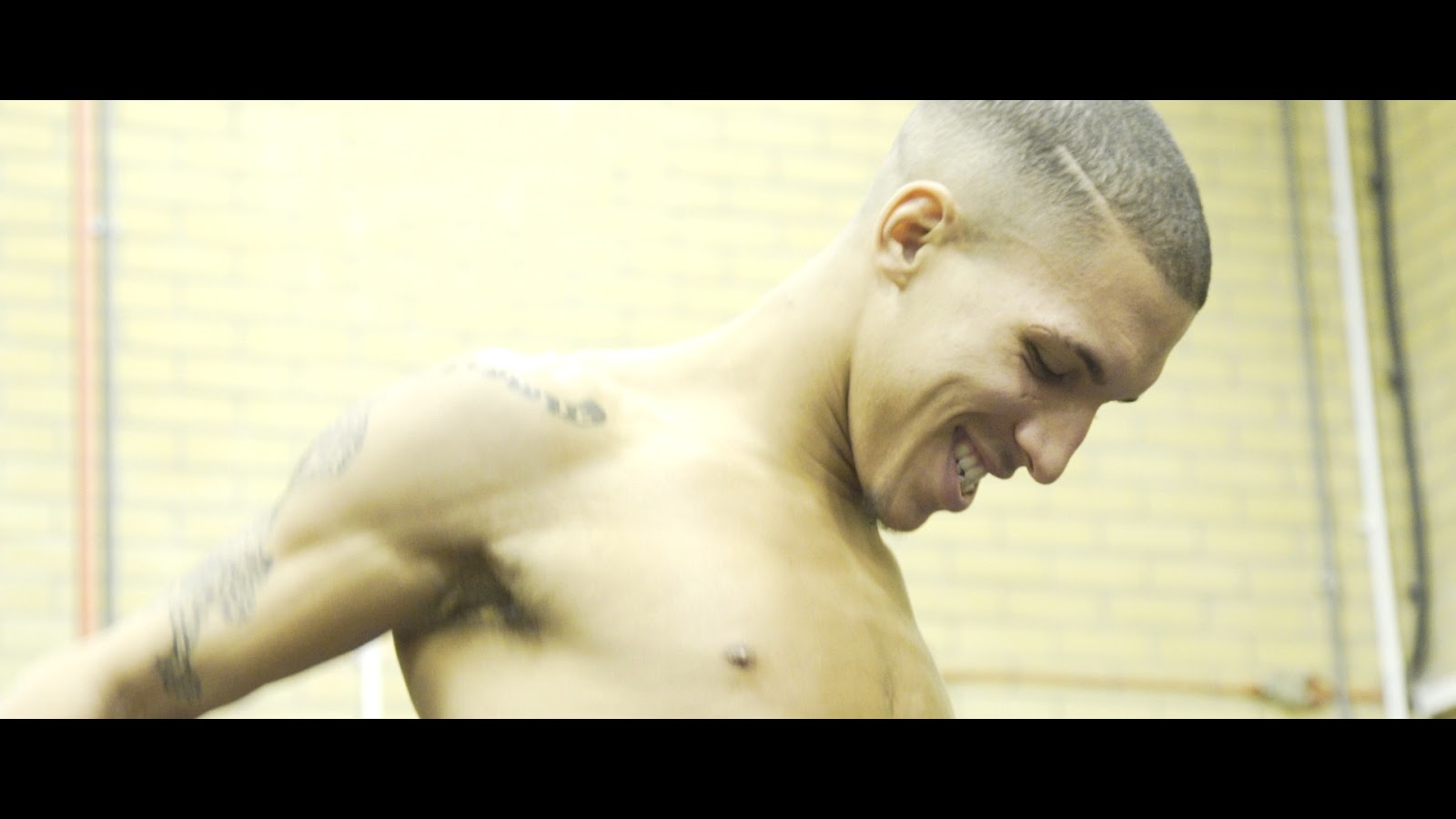
Because i had not set up my white balance properly, there was a slight greenish feel on some of the clips. The white balance issue was a bit of a challenge for me to remember to change at each room, as due to everything happening so fast, it was something that i’d overlooked, which resulted in me having one set white balance for all the footage recorded at medway park. So during post production, this is something i will have to correct using the lumetri scope tools to help amend the colour for the footage.




Sound
As for crew, i managed to ask a friend of mine to help me out on getting audio coverage during the boxing match, because as i would be moving around and potentially stopping and starting my camera etc… Chris being their covering audio, he would make sure that there is a constant crisp recording of the entire match without interruption, so he came along with his sound equipment to cover the boxing match audio for me, using his Zoom H6, Beyer dynamic MCe86/2 hypercardiod directional shotgun mic and boom pole plus blimp to get crisp clean audio of the boxing match from the side of the ring, capturing the the clashing of the leather boxing gloves, the dancing feet on the boxing canvas and also the audience atmosphere. He also used the Zoom H4 as an optional back up audio coverage for just the crowd if i wanted to use any sound of it during the edit.
Because of the hypacardiod directional mic Chris was using, he turned down the gain on his recorder so that the range of it mainly eliminated the background crowd atmosphere and solely focused primarily on the boxing match.
Here's some pictures of Chris at work, operating his sound equipment.


Tag :// Final Major Project,
Tag :// Production,
Tag :// production prep work,
Tag :// Project Update

Profile

Figure 1. Messenger,
Kent. (2014). Sheerness middleweight Oli Edwards says the sky's the limit ahead of his first bout as a professional at York Hall on December 5 [Diagram] Available at: http://www.kentonline.co.uk/sheerness/sport/fighting-talk-from-new-pro-23556/ [Accessed 26 April. 2016].
Contributor: Oli Edwards
Occupation: Professional Boxer
Age: 21
Story: Oli was robbed at knife point when he was a child (8-9) which traumatised him and had a major affect upon his life, changing him into a timid scared child, who lacked self confidence which led to him becoming a victim of constant bullying throughout childhood. Due to this childhood experience, it has been the catalyst for leading Oli on an unexpected successful path as a professional boxer, as a form of atonement for what he yearned for when he was a child.
Having phoned up Oli and having a brief conversation about if he would be interested in having a portrait documentary created about him, i arranged to meet up with him over at Minster Golden Gloves boxing gym in sheerness where he trains, so that i could find out whether or not his history and reasoning for getting into boxing, would make for a good interesting narrative structure that an audience might potentially want to find out about.
The purpose of this meeting was to:
1:Talk to Oli in order to asses if his story would make for an interesting story that an audience might want to hear about, plus if it has a narrative structure (beginning, middle, end)
2: Have a brief scout of this location to see how it is laid out, plus what takes place at the gym, as hopefully a lot of the scenes would be taking place at this gym.
3: If he agrees on going ahead with the documentary, finding out his availability and training schedule.
During the session, i had a talk with Oli’s partner who told me a lot of interesting stories of Oli’s past which was very good, and helped to paint a picture of Oli’s journey. At the end of the session, this helped me to ask Oli further questions about his upbringing, why he got into training, and what drives him to be a professional boxer.
I was also able to note down the training that Oli does, and the locations of where he trains at.
Because at the moment Oli is training for his 3rd professional fight that is coming up on the 5th of March, he mentioned it would be best if we conducted filming after his fight, as i would want to film him in more of a controlled environment, allowing me to stop and start training and get him doing additional scenes, which would interrupt his training.
As for the name of the portrait documentary, i'm not too sure what it will be called at this moment.
Conclusion
Having met with Oli and have a brief talk with him, what i need to now do is:
Arrange a proper pre interview meeting with him so that i can further elaborate on his history of being bullied, and how this made him want to get into boxing.
Arrange to shoot his professional boxing match on the 5th of March, incase there’s any footage that i might want to use in the portrait documentary of that night.
Although it is very early to be committing myself to any filming before i have finalised the narrative structure for the portrait documentary and style, however, incase there’s any important moments that happens on that night of the event, i do believe it would be best for me to go and document that night incase i miss anything important.
Tag :// Final Major Project,
Tag :// Idea development,
Tag :// production prep work,
Tag :// Project Update,
Tag :// Research

Project plan
Initially to begin with i was not too sure what i wanted to do for my final major project, given the circumstances under which i was not able to prepare properly, however, because of freelance work i occasionally do outside of university, this given me the opportunity to gain access to a few professional athletes whom i’ve met whilst freelancing, to which upon discussion with Simon, i suggested that i wanted to do a portrait documentary.
The person on which the portrait is going to be based on is a prospect boxer called Oli Edwards, whom is from the Isle of Sheppy in Kent, and is a popular boxer.
The reason that i want to do a portrait documentary, is because it is a skill of mine that i would like to try work on and improve, as working doing a documentary, the core skill that is important is trying to flesh out a good story that will encapsulate the audience from beginning to end, assisted by the use of good visual and sound. I would also like the chance to work in an actuality environment with an actual person being themselves rather than acting, filming them as they be themselves whilst constructing the images together with their commentary to create a stylistic portrait documentary like you would find on the filmmakers platform Vimeo, as this should give me more of an insight plus experience on working with normal people dealing with their everyday lives; whilst documenting it.
As this portrait documentary will have the interviewee narrating his own story, i have to make sure that an adequate amount of research, especially within the preinterviews, is carried out so that i'm able to construct a narrative structure to the story that will help me to then create answers to get my interviewee to tell me his story, or rather the story that i need in order for the narrative structure to flow nicely.
What is a portrait documentary?
A portrait documentary can be classed as an expository documentary, as it uses a combination of shots, voice-over narration and interviews to present an intimate film of an individual. (Hooper: 2011)
Hooper, Riley. "Documentaries Defined". Vimeo. N.p., 2011. Web. 26 Apr. 2016.
Bill Nichols in his book Introduction to documentary states that "Personal portrait documentaries take up social issues from a personal perspective. Individuals recruited to the film attest to or implicitly live out the underlying issue without even necessarily identifying it.” (Nichols, 2001:164) He then goes on to give a list of what a portrait documentary consists of, listing out that a personal portrait documentary includes: “Poetic or subjective discourse. Style counts as much as content; from is what counts - the reality of seeing the world from a distinct perspective […] Private moments […] Rights to privacy […] Psychological depth to characters […] Stress drama of experiencing a problem or situation."(Nichols, 2001:164-165)
Nichols, Bill. Introduction To Documentary. Bloomington: Indiana University Press, 2001. Print.
The role that i will be playing during my final Major project will be as a creative documentary maker. This is a multi skill facet role that will include me being a: Producer, Director, cinematographer, Editor / Colourist, Sound designer. Basically a jack of all trades.
Establishing what i want to do, now i need to:
Arrange meeting with Oli to find out whether or not he has a good story
Find out when he is available - what days he is free


